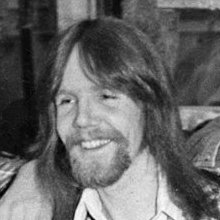
Long after he fell off the Winnipeg music
radar, guitarist and songwriter John
Hannah had retained a loyal following.
He had been living in his birth country of
Scotland for many years but would
frequently come back to Winnipeg to appear
at local clubs. For many, he became a bit
of a mystery man, a legend with occasional
sightings. Although he recently died at
age 73 in relative obscurity, Hannah left
an indelible mark on Canadian music and on
me.
Hannah came into my orbit through bandmate
and high school buddy Ralph James. “John
was in my Grade 10 class at Grant Park,”
James recalls, “and I noticed The Who
stickers on his binder.”
Hannah’s family arrived in Canada in 1957.
His father was an architect and artist.
Hannah had been at a boarding school in
Switzerland prior to arriving at Grant
Park High School. A huge British rock
music fan, Hannah had been playing guitar
since age seven. In the fall of 1969,
James invited me to a jam at drummer Rod
McFayden’s Campbell Street house. Hannah
was there and the jam ultimately led to
the formation of electric blues band Pig
Iron.
“We were just high school kids but we
really had fun playing together,” James
says.
Indeed, within a matter of weeks, Pig Iron
was making waves on the local scene.
Hannah’s abilities as a guitarist and
songwriter grew by leaps and bounds. He
also had a knack for creating songs
spontaneously, including setting the
Fireplace restaurant menu, where we often
played for food, to music.
“John just loved playing in a band,” James
says. “He was naturally talented and one
of the funniest guys I’ve ever met. A
total individual.”
Hannah left Pig Iron in early 1970, having
outgrown our Savoy Brown and John Mayall
covers. While the rest of us carried on
for another six months, Hannah became a
journeyman musician, serving time in
several name bands such as Chopping Block
and Blakewood Castle (with James) before
fronting his own groups that featured his
original compositions.
In succession, he had Wood ‘n’ Hannah
(with equally talented guitarist Dave
Wood), Hurricane Hannah and Holy Hannah,
the latter with Hannah coming onstage
sporting large angel wings and playing his
distinctive double-neck guitar. In
between, he formed the short-lived band
Moon with jazz saxophone player Tommy
Ponce, drummer Vance Masters and James.
“Moon was the band where Hannah really
blossomed as a writer,” James says. “It’s
a shame we never recorded.”
Hannah was also a founding member of
Harlequin with James, having picked up the
name from a Toronto band he played in
briefly. If that wasn’t enough, Hannah
also found time to offer guitar lessons at
Guitarland on West Broadway.
I would run into him from time to time and
was always pleased for his success.
“It was difficult being John’s sister,”
says Lesley Hannah, two years younger than
her famous brother. “He was such a legend.
I had guys wanting me to introduce them to
him and girls who befriended me because
they wanted to sleep with him.” Lesley
left Winnipeg in 1975 but remained close
to her brother for the rest of his life.
“I was very protective of him.”
Already a celebrity on the local scene,
Hannah’s star rose nationally in 1979 when
he was invited to join what was then one
of the finest bands on the Canadian rock
scene, Streetheart, which was fronted by
singer Kenny Shields. Hannah brought his
considerable guitar chops and songwriting
experience to the band, touring
tirelessly, appearing on three of the
band’s platinum- selling albums and
earning a Juno Award.
“His arrival kind of saved the band,”
notes longtime Streetheart keyboard player
Daryl Gutheil. “Paul Dean (guitarist,
songwriter and founding member) had left
and there was so much momentum around us
that we needed to get a replacement
quickly and carry on. We had a big tour
booked opening for Rush as well as a
second album to record. We were based in
Winnipeg by then and knew of John. There
was no time nor need to audition him, he
came to a practice, we played a bit and
that was it.” Hannah brought a backlog of
original songs to the band. “That lick in
Hollywood, that was so clever and so John
Hannah,” Gutheil notes. “He had a gift. He
was very prolific, always writing songs.”
Joining Streetheart was life in the rock
‘n’ roll fast lane and Hannah coped well
initially. He was living his dream. But as
one former associate noted, “John had all
the talent any could ever imagine but he
had his demons.”
In Los Angeles with the band to meet with
record executives, Hannah suffered a
nervous breakdown. “It was quite sudden,
and we got him back to Winnipeg as fast as
we could,” Gutheil remembers. Hannah
checked into the psych ward at the Health
Sciences Centre. He was quickly replaced
in Streetheart by Vancouver- based
guitarist Jeff Neill and once again the
band soldiered on. Few outside his family
knew Hannah had been diagnosed as bipolar
years earlier. “He was a very private
person,” his sister Lesley says. “It was
nobody’s business.”
Hannah’s career never fully recovered. He
continued to write and record, including
several songs written with local studio
guitarist Ari Lahdekorpi and recorded with
Dave Zeglinski at Mid-Ocean Studios. “He
was in recovery at the time,” Lahdekorpi
remembers. “A couple of the songs were
apparently sent to the Jefferson Starship
producer for consideration.”
In 1993, John released his one and only
solo album of original compositions,
Desperate Times, in the form of a limited
edition 10-song cassette tape that
revealed his creativity remained strong.
He even appeared with Ron Paley’s Big
Band.
Soon after, he moved back to Scotland
where he enjoyed the support of a large
extended family. It was there, Lesley
notes, that her brother was happiest away
from the glare of being a rock star in
Winnipeg. He continued to play guitar and
write songs until his death.
“In his mind, things were always better
for him in Scotland,” Lesley says. “He had
a very full life there without having to
be the rock star.”
Reflecting on his old friend’s impact,
James, now senior vice-president of Paquin
Entertainment in Toronto, is emphatic: “I
wouldn’t have had a career in music or be
where I am today without John Hannah.”
Lesley displays her brother’s Juno Award
in her home in British Columbia.
“I’m very proud of his accomplishments and
we never discussed his failures,” she
says. ”He was so talented and that’s what
we need to remember. To the end of his
life, he was loved.”
John Hannah, a Scottish-Canadian guitarist
and singer-songwriter best known as a
member of Streetheart, died at his
residence in Ayr, Scotland after a brief
illness, on Feb. 20, at age 73.
On their website, Streetheart reported the
news and noted that "John joined
Streetheart in the fall of 1978 and was
with the band until the early spring of
1981. John’s contribution to the
Streetheart legacy during that time was
most profound. Along with being an
accomplished guitarist and singer, he was
also a creative force, contributing to
many of the classic Streetheart songs that
remain as fan favourites today.
'Hollywood,' Trouble, and 'Drugstore
Dancer' all feature John’s songwriting and
playing skills and it is John who played
the iconic guitar solo on Streetheart’s
classic remake of The Rolling Stones’
'Under My Thumb' in 1979."
Hannah recorded three albums with
platinum-selling Winnipeg rockers
Streetheart: Under Heaven Over Hell,
Quicksand Shoes and Drugstore Dancer. He
was in the band when Streetheart received
their Juno Award for most promising group
in 1980, but departed the following year
for health reasons.
Streetheart's post notes that "After
Streetheart, John divided his time between
Winnipeg and his home in Scotland and he
maintained many long time friendships in
Winnipeg over the years. John was a very
soulful, spiritual and playful person in
life, those attributes being the stuff
that we are holding on to today as we look
back on our time spent together. RIP John,
we know your ancestors will be waiting to
welcome you with open arms on the other
side."
Born in Glasgow, Hannah moved to Canada
when his family emigrated to Winnipeg in
the late 1950s. Prior to joining
Streetheart, he had made a mark with
multiple prominent rock bands on the
Winnipeg scene, including Pig Iron and
Chopping Block. Most notable of these was
Wood 'n Hannah, a project with David Wood.
In 1976, Winnipeg Free Press writer Andy
Mellen wrote that "David Wood and John
Hannah's tremendous dual-guitar interplay
-- which forms the integral part of the
band's sound for songs like 'Back On The
Scene,' 'Polynesia' and 'Wood Work' -- is
characterized by some of the sweetest
sounding, intensely delivered playing it
has been my pleasure to hear in a long
time."
In a Facebook tribute, fellow Winnipeg
musician Stan Bedernjak recalls that "my
personal connection to John Hannah came
earlier in life when I hooked up with
David Wood, who had been in a couple of
versions of a Winnipeg favourite named
Wood 'n Hannah. Incredibly talented and
extremely creative, they ruled the roost
in Winnipeg as one of the most dynamic and
original-sounding groups. John and Dave
were a guitar duo like no other."
This band was short-lived, however, as, in
Jan. 1977, Mellen reported in the Free
Press that "In a shocking and totally
surprising development, The Wood 'N Hannah
band has ceased to be. I had no advance
warning at all of the move, which took
place on Christmas Day.
"It seems unbelievable that a band I felt
possessed the potential for greatness no
longer exists. I was a great supporter of
The Wood 'N Hannah band right from its
inception nine months ago. Of all the many
talented Winnipeg band on the scene, I
felt that this band had the best shot at
advancing well beyond the local pub and
one-nighter circuit. There's no question
that the talent (and more importantly the
original material) to achieve wide
recognition was there in abundance."
The nucleus of that group
(singer-guitarist John Hannah, drummer
Harvey Kostenchuk and late bassist Scott
Smith, who went on to fame in Loverboy)
carried on under the name of Hurricane
Hannah, prior to Hannah getting the call
to replace Paul Dean (later to join
Loverboy) as guitarist in Streetheart.
David Wood's next project was the band
Woodwork.
After leaving Streetheart, Hannah recorded
and released a solo project, Desperate
Times, out on cassette in 1983. On
Facebook, Winnipeg musician Alec Friesen
recalls that "I met John through Dave
Zeglinski (owner of Mid Ocean recording
studios on Erin) in 1983. John and Dave
were very good friends with John recording
at Mid Ocean and Dave engineering and
producing sessions.
"Out of these sessions came John Hannah's
only solo album release that I know of,
Desperate Times. It contains 10 wonderful
tracks featuring all John Hannah
compositions ranging from Funk,
Progressive AOR, and of course the
absolute thunderous riff rock that John
was so known for. John was also very
skilled as a singer and storyteller.
"Desperate Times is a testament to John's
tremendous talent. The album also features
a veritable buffet of Winnipeg talent as
can be seen on the liner credits. I am
grateful for the opportunity to have
participated on the record. My hope is for
it to to have a modern digital release so
this great music can be truly
appreciated."
In his post, Stan Bedernjak reports that
"After he left Streetheart, John kept a
low profile, and I was lucky enough to get
him to join up with me in a couple of
different jam bands. We played at the old
Johnnys on Sunday nights and I remember
the night we warmed up Edgar Winter at the
Rolling Stone Cabaret. Playing with John
was always a pleasure. A soft-spoken guy
who loved music and chillin' out."
"He ended up doing Jam nights at the Royal
George once a week in the summers, and
would go back to Ayr, Scotland, his home
for the winter. He had a one-man band
thing going over there, which he had tried
here in Lockport to good turnouts. John
also played with The George's Greg
Pester's band Sassy Jack. His last time in
Winnipeg was just before the COVID
shutdown. He was supposed to come back and
start up the jams again, but it never
happened."
To Billboard Canada, Bedernjak recalls
that "John was also a guitar teacher back
in the day, at Guitarland, and he actually
started out as a bass player prior to
switching to guitar."
All of us in the Streetheart family are
deeply saddened to hear of the passing of
Streetheart alumnus and long time friend,
John Hannah who passed away at his
residence in Ayr, Scotland yesterday.
John joined Streetheart in the fall of
1978 and was with the band until the early
spring of 1981.
John’s contribution to the Streetheart
legacy during that time was most profound.
Along with being an accomplished guitarist
and singer, John was also a creative
force, contributing to many of the classic
Streetheart songs that remain as fan
favourites today. Hollywood, Trouble,
Drugstore Dancer all feature John’s
songwriting and playing skills and it is
John who played the iconic guitar solo on
Streetheart’s classic remake of The
Rolling Stones’ "Under My Thumb" in 1979.
John recorded three albums with
Streetheart, Under Heaven Over Hell,
Quicksand Shoes and Drugstore
Dancer. John was also a part of the
band when Streetheart received their JUNO
Award for Most Promising Group in 1980.
After Streetheart, John divided his time
between Winnipeg and his home in Scotland
and he maintained many long time
friendships in Winnipeg over the years.
John was a very soulful, spiritual and
playful person in life, those attributes
being the stuff that we are holding on to
today as we look back on our time spent
together.
As sad as we are to hear of John’s
passing, we have nothing but good thoughts
about John and we would like to extend our
sincere condolences to John’s family and
all those who knew and loved John.
RIP John, we know your ancestors will be
waiting to welcome you with open arms on
the other side.
Our thanks to another Streetheart family
member, Bob "Herb" Ego for the photo
collage of John. Thank you Herb, lots of
love from all of us.